 RadiusMapper
Free walking distance calculator
Walking Distance Calculator
Walking Radius Map & Walk Time Calculator
Free walking distance calculator. Pick an address, set a time (5 minutes, 15 minutes, an hour), and we show the real area you can walk to. Sidewalks and street grid matter more than a circle on a map. Used by real estate agents checking walk scores, retailers sizing foot traffic, and planners working on 15-minute city goals.
Create Walking Radius Map
Interactive Walking Distance Map
Definition
What is a walking radius?
A walking radius is the area a pedestrian can reach on foot from a starting point within a given time, following actual sidewalks, crosswalks, and pedestrian paths. RadiusMapper uses an average walking pace of 3 mph (5 km/h), the typical speed for healthy adults on flat terrain.
Also called walking isochrone, walk-time map, or walkshed. All describe the same polygon; academic urban-planning papers usually prefer 'walkshed.'
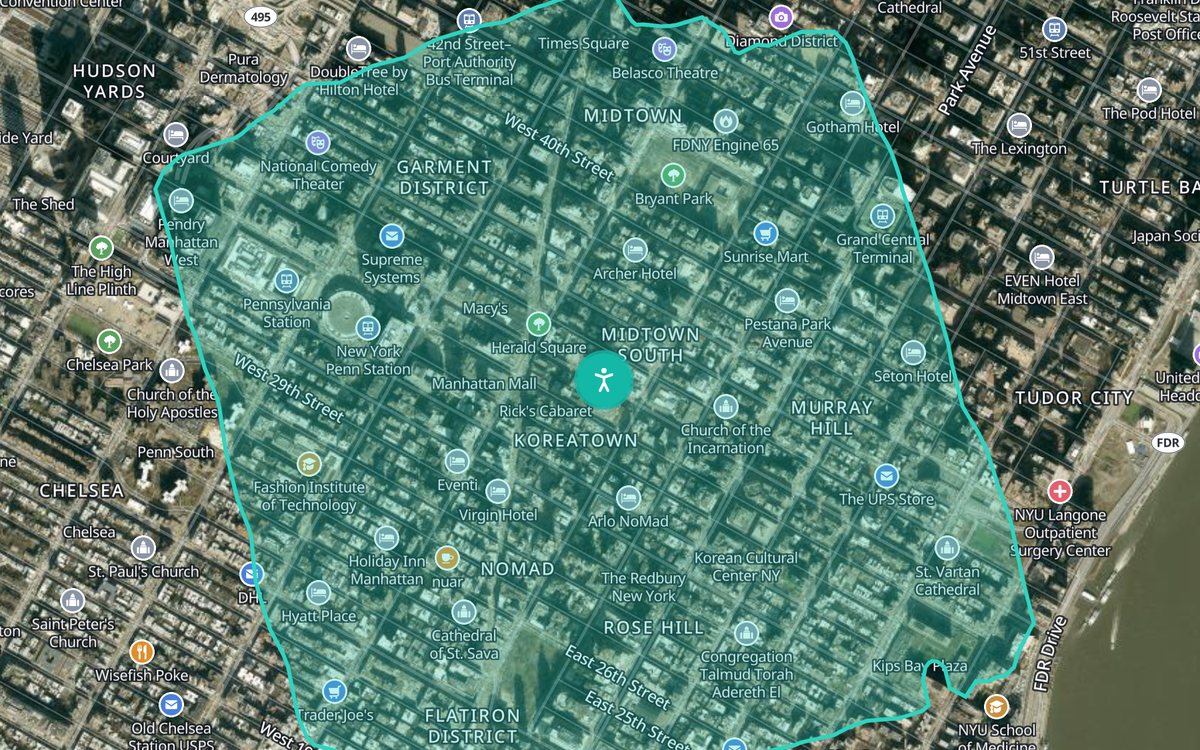 15 min walk · Midtown Manhattan
- A 5-minute walking radius covers roughly 0.2-0.25 square miles (about a quarter-mile crow-fly).
- A 10-minute walking radius, the benchmark for '10-minute city' planning, covers 0.6-0.9 square miles.
- A 15-minute walking radius, the '15-minute city' benchmark, covers 1.3-1.8 square miles.
- Walkability studies and Walk Score methodology typically use 5, 10, and 20-minute thresholds.
Other modes
Explore Other Travel Modes
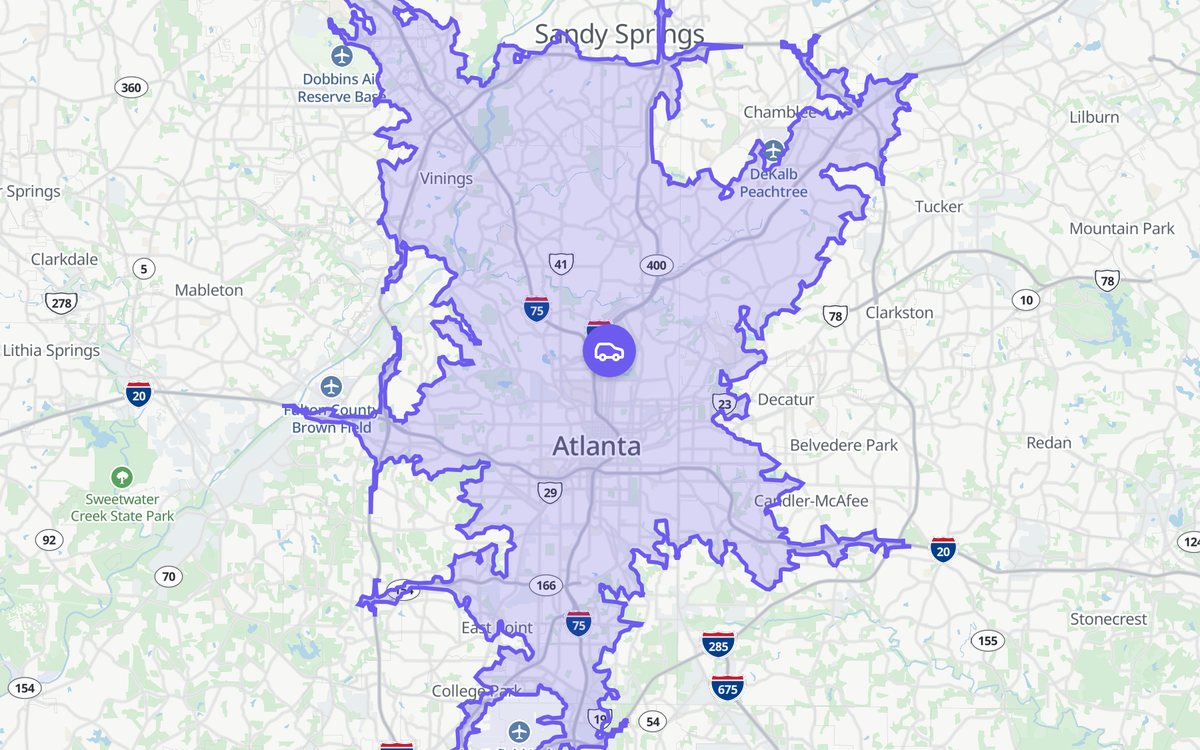 20 min drive · Atlanta
Drive Time Radius
Calculate driving distances and analyze commute times
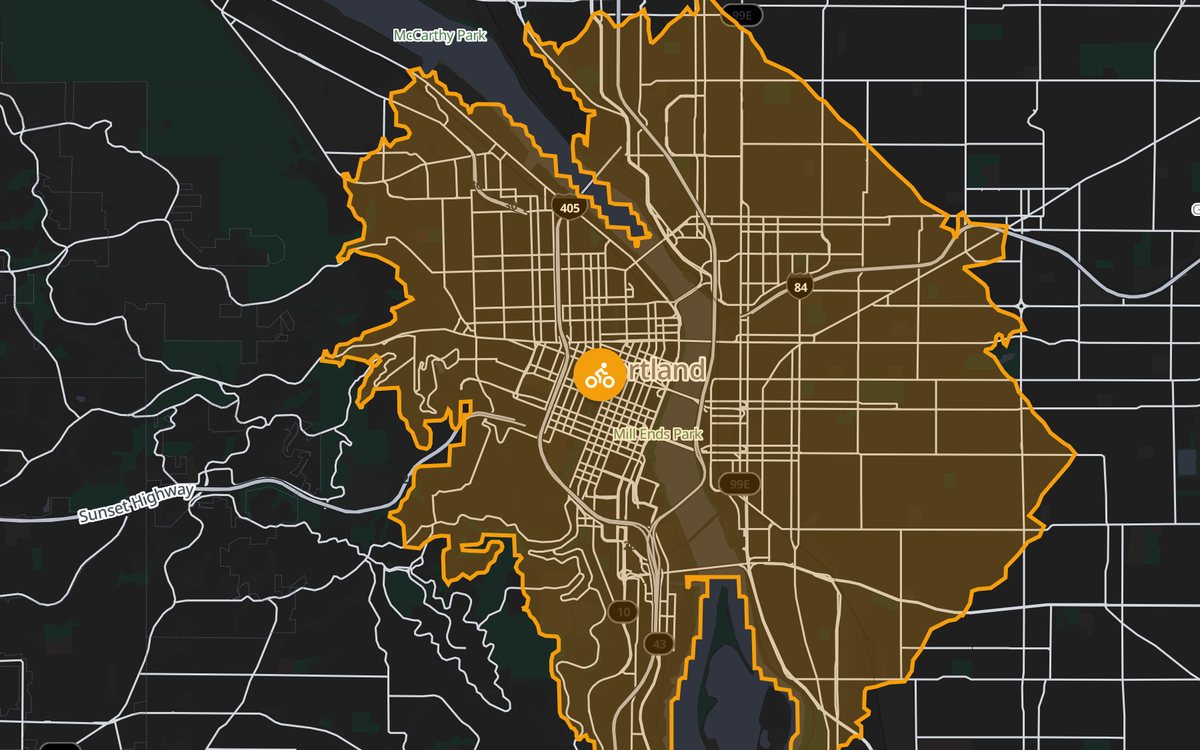 20 min bike · Portland
Cycling Distance Map
Map cycling distances and bike accessibility
In practice
Who uses walking radius maps
Real estate
Redfin and Zillow both surface Walk Score on listings, but neither shows the actual walkshed. A 10-minute walking radius overlay backs up "walkable to the L train" with a visible boundary a buyer can inspect block by block.
Retail & restaurant siting
Starbucks' site-selection model uses a 5-minute pedestrian catchment for urban stores; Dunkin' targets 3-minute primary walks in Manhattan and Boston. The first filter for any urban QSR is a walkshed, not a drive-time radius.
Urban planning
Paris's 15-minute city program audits every arrondissement with walkshed overlays. Portland, Melbourne, and Copenhagen run the same analysis at the census-tract level to score equity of access to schools, groceries, and clinics.
Walksheds
Why a walking radius isn't a circle
A pedestrian walks at about 3 miles per hour. That sounds like a clean input for a circle: 15 minutes × 3 mph = 0.75 miles. Draw the circle, done.
Except the pedestrian doesn't walk through buildings. Or across the freeway. Or past the six-lane arterial with no crosswalk for four blocks. Drop a walking radius on Midtown Manhattan and the shape is nearly circular because the grid is dense and crossings are everywhere. Drop the same 15-minute radius on a Phoenix suburb and it collapses inward on itself. Huge chunks of the circle are cul-de-sacs, highway frontage, and loops that dead-end before the edge of the polygon.
A real walking radius follows the actual pedestrian network: sidewalks, crosswalks, trail connectors, building passages. Tools like Walk Score and the 15-minute city framework use this polygon (not a circle) because the gap between "theoretically walkable" and "practically walkable" is massive in the US. A Houston address might have a Walk Score of 30 not because the density is wrong but because the network is broken. A circle shows what could be walkable. The polygon shows what is.
This page generates the polygon. Enter an address, pick a time budget, and the map shows where a person on foot actually gets to, not where geometry says they should.
Two questions
Walking Distance Calculator vs. Pedestrian Accessibility Analysis
Two common questions that look similar but have different answers: "how far can I walk?" and "can people walk here?" The first is a personal calculation. The second is an accessibility audit.
Walking Distance Calculator
A walking distance calculator answers "what's in range on foot right now?" It treats the walker as the unit: set a time budget (15 minutes), set an origin (a home, an office, a hotel), and read off the amenities inside the polygon. Simple and personal.
Most people find this tool while comparing apartments ("is the grocery store walkable?"), planning a trip ("what's near my hotel?"), or thinking about a daily routine ("can I walk to the gym before work?"). The map above does this directly. Enter an address, pick a time, look at what's inside the ring.
Pedestrian Accessibility Analysis
Pedestrian accessibility flips the question from the individual to the place. Instead of "how far can I walk from my front door?" it asks "how well does this neighborhood serve walkers at all?" The answer lives in patterns across many origins, not one.
Planners and accessibility consultants run this analysis all the time. Typical questions:
- What share of residents in this district have a grocery store, school, and pharmacy inside a 10-minute walk?
- Which bus stops are outside a 5-minute walk for more than 30% of the surrounding block population, so transit planners know where to add one?
- Where are the "pedestrian deserts," residential areas where a 15-minute walk reaches no daily-needs amenity at all?
- How does a new sidewalk, crossing, or land-use change affect the walkable catchment around it?
The same map answers both. For background on walkability metrics and how Walk Score fits in, see the Walk Score explainer, or read our 15-minute city walkability guide for the planning framework.
How it works
How to Create Your Walking Radius Map
- 01
Enter Your Location
Type any address, neighborhood, or landmark as the center point for your walking radius calculation.
- 02
Set Walk Time
Choose how many minutes you want to walk, from a quick 5-minute errand to a 30-minute neighborhood stroll.
- 03
View Your Radius
Instantly see a walking radius map outlining every block, park, and amenity reachable on foot in that time.
Real examples
Who uses walking radius maps (with real examples)
Real estate listings
A broker lists a Park Slope walk-up and needs to prove the 5-minute walk to the F train. A walking radius overlay on the listing shows the exact walkable area, crossings and construction included. Buyers can see it for themselves instead of asking.
QSR site selection
Chipotle's real estate team looks at a 5-minute walking catchment for urban stores. They lay that shape over daytime population, and only sites with 8,000 or more daytime residents inside it get a visit. The rest are dropped at the first pass.
15-minute city audit
Paris requires every arrondissement to document what share of residents have groceries, schools, and healthcare inside a 15-minute walk. The audit runs across all 1.1M addresses; the tool generates the polygon and checks amenity density inside it. Portland and Melbourne run the same workflow annually.
School walk-zone policy
A district rewrites its walk-zone boundary after a new arterial installs a median. Walking radius overlays from every elementary school show which students are now walking farther than the 1.25-mile state guideline. Bus routes adjust accordingly.
Transit access analysis
SEPTA plans a new bus stop and needs to know how many new riders fall inside a 5-minute walk of it. A walking radius from the proposed stop location answers the density question before capital spend gets approved.
Accessibility and equity research
Harvard's Joint Center for Housing Studies uses walksheds to measure grocery access in low-income tracts. The method: draw a 15-minute walking area from the center of every Census block and check whether a full-service grocer falls inside it. Tracts where none does are food deserts.
15-minute city
The 15-Minute City Test
The 15-minute city is a planning concept popularized by Carlos Moreno, a professor at the Sorbonne in Paris, and adopted by cities including Paris, Melbourne, Portland, and Copenhagen. The idea is simple: every resident should be able to meet their daily needs (groceries, schools, healthcare, work, parks, culture) within a 15-minute walk or bike ride of home.
A walking radius map is the most direct way to run the 15-minute city test on any address. Drop a pin on a home, set the walking radius to 15 minutes, and inspect the resulting boundary: does it include a grocery store, a pharmacy, a primary school, a green space, a transit stop, and at least some employment? If the answer is yes across all six categories, that address passes the 15-minute test. If not, the gaps show urban planners exactly where the neighborhood falls short.
Academic research on the 15-minute city uses the same logic at scale. Studies across European and North American cities typically find that dense, pre-war neighborhoods pass the test easily, while post-war suburban layouts (highway arterials, single-use zoning, fragmented sidewalks) almost never do. A walking radius calculator is the quantitative tool that lets planners, housing advocates, and curious residents see which side of that line their own block sits on.
For a deeper look at the history, the critiques, and the data behind the 15-minute city, read our full guide on the 15-minute city and walkability in urban planning.
- 1Grocery store
- 2Pharmacy
- 3Primary school
- 4Green space
- 5Transit stop
- 6Jobs
Tips
Walking radius calculator tips: what actually changes the polygon
What shrinks a walkshed
- Steep hills. A 10% grade cuts walking speed by about 25%. San Francisco's steepest blocks are 15 minutes of vertical on a map that reads 0.8 miles.
- Missing sidewalks. Roughly 25% of US arterials have no sidewalk on at least one side. Pedestrians either cross traffic or walk in the street, both of which collapse the polygon.
- Major arterials without mid-block crossings. Stroads like Houston's Westheimer Road or Atlanta's Buford Highway can force a 5-minute detour for one 30-foot crossing.
- Rivers and highways without pedestrian bridges. The Anacostia in DC, the LA River, the Los Angeles elevated freeways: each cuts what looks like a continuous walkshed in half.
What expands it
- Mid-block pedestrian passages. Boston's older neighborhoods have 18th-century alleys that aren't on most driving maps but add real connectivity.
- Transit stations. A BART or Metro entrance inside the walkshed lets you hop to another part of the city from one end of your walk.
- Mixed-use ground floors. A walkshed past a dense block of shops feels shorter than one past a parking lot; Walk Score weights this heavily for a reason.
- Flat terrain with a grid. Manhattan walksheds approach theoretical maxima because every step counts. Hilly sprawl like Dallas barely reaches 40% of the possible polygon.
Guides
Walking Radius Guides & Resources
The 15-Minute City & Walkability
How the 15-minute city concept reshapes urban planning and how to use a walking radius map to test any neighborhood.
Read the full guideMost Walkable Neighborhoods
A walkability map deep-dive into the most pedestrian-friendly neighborhoods in the US and what makes them work.
Read the full guideWalk Score Explained
What walk score actually measures, how it's calculated, and how walking radius maps complement the metric.
Read the full guideCatchment Area Analysis Guide
How to model walking catchment areas for retail, schools, and public services using radius-based analysis.
Read the full guideBy city
Walking Radius Maps by City
Explore walking radius maps and walkability data for the world's most walkable cities
FAQ
Walking Radius Map FAQs
What walking speed does RadiusMapper use?
3 mph (5 km/h), the pace the US Federal Highway Administration adopts as the design standard for adult pedestrian timing. That's the speed a healthy adult maintains on flat, unobstructed terrain. The actual polygon adjusts downward for hills, crosswalks, and signal wait times automatically.
Why does my walking radius look so weird in some cities?
Because the walking network is unevenly distributed in the US. Drop a 10-minute walkshed on downtown Manhattan and it's roughly circular. Drop the same 10-minute walkshed on suburban Dallas and huge chunks disappear: missing sidewalks, cul-de-sacs with no through-connection, arterials with half-mile crossing gaps. The polygon is showing you real pedestrian infrastructure, not a theoretical circle.
What is the 15-minute city?
A planning concept popularized by Carlos Moreno at the Sorbonne in 2016. The test: every resident should be able to reach groceries, schools, healthcare, employment, parks, and civic services within a 15-minute walk from home. Paris mandated it in 2020 as a post-pandemic urban policy; Portland, Melbourne, and Copenhagen have adopted versions since. The walking radius polygon is the measurement tool. It shows whether a given address actually passes the test.
How does a walking radius map relate to Walk Score?
Walk Score aggregates amenity counts inside a ~1-mile radius, weighted by category. It produces a 0–100 number. A walking radius map shows the raw polygon Walk Score is computed over, so you can see WHICH amenities fall inside the walkshed, not just how many. Realtors link to Walk Score; a walking radius map is what you use when the score feels wrong.
Can I use this for school walk-zone planning?
Yes, and districts do. Most states have walk-zone guidelines (usually 0.5–1.5 miles depending on grade level); districts use walking radius polygons to determine which students fall inside the zone vs. need bus service. The polygon matters because a student living 0.7 miles away but across a highway with no crossing is effectively outside the walk zone, even if the straight-line distance says otherwise.
Why not just use a distance circle?
A 0.75-mile circle drawn at any address in Phoenix overlaps freeways, strip-mall parking lots, and private lots that pedestrians cannot cross. The circle says the area is reachable. The sidewalk network says it isn't. Walk Score's actual algorithm uses the walkshed, not the circle, for exactly this reason.
See who lives in your area
Layer population, income & housing data on any travel-time map. Free to start.